



By Dr. Kelly Marino
Not long after their marriage, Katharine Fearing Hubbard and Colonel Clarence Seymour Wadsworth began considering a location in western Middletown, Connecticut for a new summer residence. Wadsworth, whose family had founded Hartford’s Wadsworth Atheneum, was a Harvard graduate, lawyer, and political figure, later serving in the Connecticut General Assembly as a Senator from the 33rd District. Hubbard was the daughter of Elijah Kent Hubbard, owner of the Russell Manufacturing Co., once the country’s largest supplier of elastic webbing. Expanding on property Katharine inherited, the location that they chose and built on became known as the Wadsworth Estate at Long Hill.
The Early Days at Long Hill
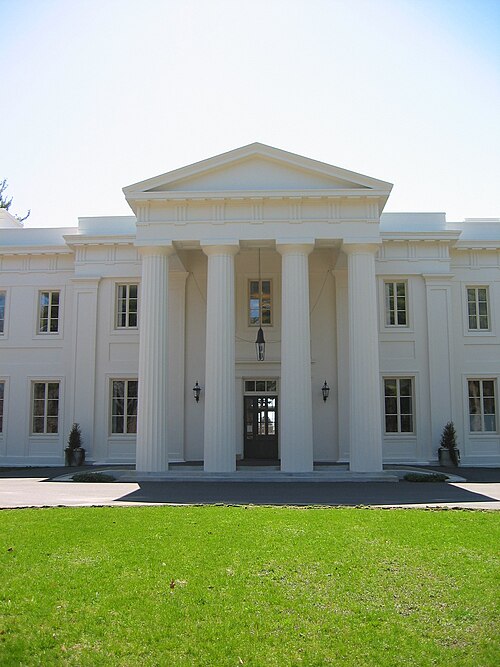
The couple worked with the landscaping firm Olmsted Brothers to design the property, including planting rare trees. The New York architecture firm of Hoppin and Koen designed the main building in a Beaux Arts style from 1908 to 1917 for $90,000. Taking inspiration from the Newport, Rhode Island mansions, Hoppin and Koen was also responsible for working on writer Edith Wharton’s house, The Mount, in Lenox, Massachusetts. Wadsworth wanted to create a serene and sustainable oasis—a beautiful sprawling property that was park-like for his family.
Across the 19th century, and especially by the turn of the 20th century, there were growing concerns about the effects of industrialization on the environment as well as public health. Many Americans sought a retreat away from urban life. Wadsworth, for example, was passionate about forestry and conservation, an increasingly popular subject in the Progressive Era. He served in Middletown on the Park Board and the Planning Commission. Deeply invested in the cause, he took these issues into consideration in the management and development of his property for several decades.
From Private Residence to Community Space
In 1941, however, Colonel Wadsworth died, and the land surrounding the estate was split up. Some land passed to the State of Connecticut and became Wadsworth Falls State Park. The Rockfall Foundation took over the management of the rest of the land. Wadsworth started Rockfall Foundation in 1935 and tasked it with coming up with ways to manage the financial and property resources that he had owned in Middletown and Middlefield. The Rockfall Foundation, considered one of the earliest environmental preservation endowments, still operates from another historic property owned by the family in Middletown, the deKoven House.
From 1947 to 1986, Our Lady of the Cenacle, an order of nuns, took ownership of the Wadsworth Estate. It became a retreat center, offering a place to stay, meditation, and religious instruction. Since upkeep on such a large property was expensive, they sold more portions of the property around the mansion to keep the facility afloat. The original land holdings were reduced from about 600 acres during Wadsworth’s time to about 103.5 acres by this period. The nuns, however, did add two new wings to the main building.
The Restoration of the Wadsworth Mansion
In 1986, the property was sold and passed from developer to developer. None were able to create a solid plan that would be profitable. As time passed, the building and the land around it became abandoned, sat decaying, and eventually was targeted by vandals and arsonists. A particularly bad fire in one of the ballrooms destroyed part of the structure; luckily architects had used relatively innovative concrete and fireproofing technology that prevented greater damage. Banks ultimately repossessed the property while preservationists and conservationists worked to lobby the city of Middletown to save it.
Middletown applied to the state for grant funding to help, and in 1993 commissioned an architectural and structural facility study of the location. Middletown became the official owner in 1994 and used $5.8 million in city bonds to restore the building and surviving grounds as close as possible to what it looked like under the Wadsworths. The transformation took several years to complete before the property became as it today. In 1996, the estate became part of a historic district listed on the National Register of Historic Places. Overseen by the Long Hill State Authority, it is open to the community for hikes on the grounds and a popular wedding venue and rental space with annual events, tours, and teas for the public.
Dr. Kelly Marino is an Associate Teaching Professor of History at Sacred Heart University.