


By Misa Giroux
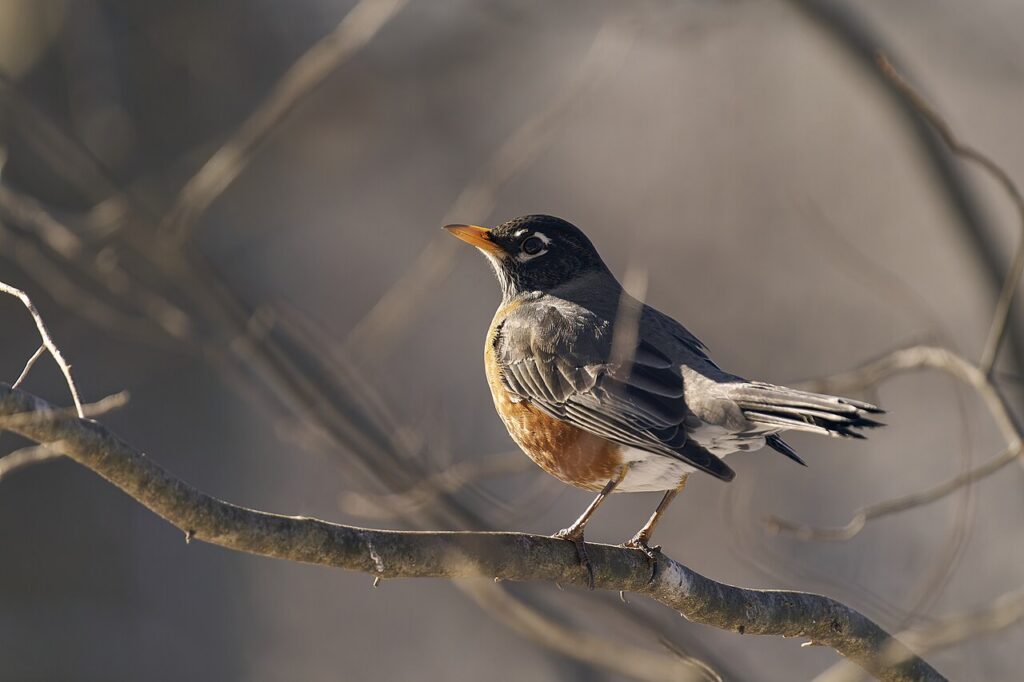
If you look out your window, there is more than a good chance you’ll see the Connecticut State Bird: the American Robin.
Recognized by their orange-red chests and bright blue eggs, American Robins belong to the thrush family—the largest member found in North America. They feature in myriad myths, stories, poems, and superstitions, most often associated with the arrival of spring. While some robins do migrate, many do spend the entire winter in New England, roosting together and feasting on winter berries.
Before this bird was given the name “robin,” Indigenous peoples had given it their own names, among them “quequisquitch” (Pequot), “opichi”/”apichi” (Ojibwe), and “tsiskóko” (Oneida). Upon their arrival in North America, English colonists gave it the name “robin” as it reminded them of a similar-looking bird back in England. According to Ernest A. Choate’s The Dictionary of American Bird Names, “Wherever the English have settled they have tended to bestow the name Robin on any bird with a noticeable amount of red or russet in the plumage.”
Besides serving as joyful harbingers of spring, robins, in their abundance, can serve as important markers for determining the health of their ecosystems. In the 1950s, trees were sprayed with the pesticide DDT in an attempt to rid them of the fungus that caused Dutch elm disease. As the vegetation was contaminated, so then were the earthworms and robins up the food chain. Environmentalist Rachel Carson wrote in her seminal work Silent Spring:
“We spray our elms and following springs are silent of robin song, not because we sprayed the robins directly but because the poison traveled, step by step, through the now familiar elmleaf-earthworm-robin cycle. These are matters of record, observable, part of the visible world around us. They reflect the web of life-or death-that scientists know as ecology.”
While their numbers have increased sevenfold from the 1960s—there are an estimated 366 million robins in North America—pesticides still threaten the health of robins and other birds today.
In 1941, it was proposed that the European robin (Erithacus rubecula) become the state bird, but in 1943, the Connecticut General Assembly moved to adopt the American robin (Turdus migratorius) instead. As of July 1st, 2026, however, the robin might have to share its title. The state Senate recently passed an amendment to honor two of the state’s basketball stars, Jordan Hawkins and Sue Bird, as official state birds every March.