



By Susan Bransfield
During the 1960s and 70s, urban renewal was a popular initiative backed by the US federal government designed to rid cities and towns of slums or blighted neighborhoods and replace them with new developments. In Portland, Connecticut, a small town located in the central part of the state, urban renewal occurred in a small neighborhood located under the Arrigoni Bridge, which spans the Connecticut River and connects the city of Middletown with Portland. In the late 1970s, Portland initiated and conducted an urban renewal program in this area under the bridge, demolishing the neighborhood of homes and businesses and replacing it with a new Industrial Park.
Urban Renewal Nationwide
Most jobs located in Portland today are in local government, retail, food services, health care, and manufacturing. From the mid-1800s until the early 1900s, Portland had hundreds of jobs in the brownstone quarries and in shipbuilding, but by the early 1930s, both the brownstone and shipbuilding industries in Portland were nearly out of business, and associated jobs were scarce.
The Great Depression and World War II brought many social and economic challenges to US cities and towns. By the 1950s and 60s, communities throughout the country, including Portland, had deteriorated housing and infrastructure. Congress addressed these needs by enacting the Federal Housing Act of 1949 and subsequent amendments. This legislation created the federal urban renewal program, a program offering grants and loans to municipalities to help them eliminate substandard housing and replace it with new housing, businesses, and other developments. In practice, however, urban renewal displaced hundreds of thousands of families and destroyed communities, often disproportionately affecting low-income communities and people of color.
Urban Renewal in Portland
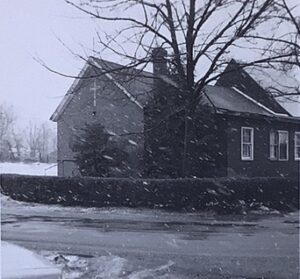
Photo of True Vine Church, 14 Lower Main Street, Portland, CT – Property of True Vine Baptist Church, 1970
Portland Redevelopment Agency, Town of Portland, CT Archives
In 1965, the Town of Portland obtained a federal grant from the Urban Renewal Administration of the Housing and Home Finance Agency to write “A Plan of Development.” The plan, written by a consultant, cited 164 residential dwellings in town that were “dilapidated, deteriorated or deteriorating.” It also recommended that Portland engage in the federal urban renewal program and establish a redevelopment agency to address the substandard housing.
Portland created the Portland Redevelopment Agency (PRA) in 1966. After conducting an analysis, the PRA selected the neighborhood that included the old town center between the Arrigoni Bridge and the Old Colchester Turnpike as the priority for urban renewal. A town vote in 1972 approved the PRA’s urban renewal plan, which included a commitment to pay the local share of costs, apply for federal grants, purchase the properties in the designated area, demolish the buildings, sell the vacant land to private developers, and build The Brownstone Industrial Park in place of the old neighborhood.
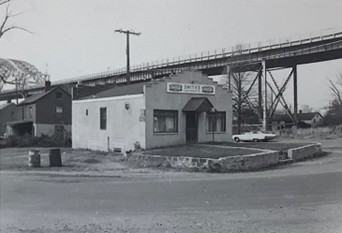
The renewal area was located near the Connecticut River under the Arrigoni Bridge, aptly nicknamed “under the bridge.” It included 57 dwellings, 11 commercial/industrial buildings, and one church, The True Vine Holiness Church, all of which were demolished. Urban renewal displaced 68 families and 15 individuals living in the neighborhood from their homes. They included people who earned low to moderate incomes and were of various racial and ethnic backgrounds.
The PRA was successful in obtaining federal Housing and Urban Development grants, as well as state and local funding. They hired appraisal firms to document the value of each property, purchased the properties for the appraised value, and demolished them using federal, state, and local dollars. PRA sold the vacant land to private owners to construct The Brownstone Industrial Park; the roads, water, and sewer utilities were also improved using grant money. The hope was that these new industries would pay more tax revenue than the former neighborhood, create new jobs, and eliminate the town’s largest concentration of run-down and blighted housing.
There was a federal requirement that every dwelling unit eliminated under the urban renewal program be replaced nearby and be affordable for the residents being displaced. The Portland Housing Authority (PHA) was created in 1968 and charged with fulfilling this requirement. The PHA built two new affordable apartment complexes in Portland, including Chatham Court for families and Quarry Heights for the elderly. Many of the residents who had lived under the bridge moved into these new apartments.
Documenting Impact of Displacement
The PRA was disbanded in 1984, having completed their work. The files of the PRA are in the Town of Portland archives and include the appraisals with pictures of the demolished houses and buildings, along with other PRA files. In 2022, members of the Portland Historical Society started to research these files and realized that while the PRA’s work was well-documented, the impact on the owners and residents of the demolished neighborhood, and in particular Black residents, had never been documented.
Starting in 2023, almost sixty years after urban renewal started in Portland, the Portland Historical Society, the Portland Library, and the Portland Solidarity Committee decided to collaborate and tell the story of urban development in Portland, including the long-lasting effects of the program on the individuals and families it touched. They conducted a series of oral history interviews with former residents, which revealed a range of memories, opinions, and emotional responses from the individuals who had lived through urban renewal and redevelopment.
Remembering “Under the Bridge”
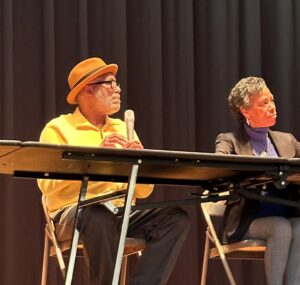
Photo of “Voices of Portland” panelists – left to right: Rev. Laurence Woods, Patricia Hall Jemison, 2024
Photograph courtesy of Portland Historical Society, Portland, CT
The Voices of Portland oral history project documents and preserves memories of the displaced “Under the Bridge” community. Recorded half a century later, many of those interviewed were children or young people when their neighborhood was demolished. Former resident Patricia Hall Jemison recalled that she felt “uprooted” when her family moved from their home under the bridge into a Chatham Court apartment. Patricia said, “So, all families that lived under the bridge—I did—and when Chatham Court was erected, it took a part of our souls away when they had us move and relocate. I grew up in a house; I had a yard. We had two cars. And then I moved to a neighborhood where people are just right there. That bothered my self-esteem for a long time.”
Another former resident, Laurence Woods, reminisced about Continental Can, the fish cannery where his father worked scaling fish. Laurence remembered eating lots of fish as a young man as well as the terrific odor of fish in his neighborhood. In the winter, Laurence would go over to Continental Can to get cardboard boxes and use them as sleds. Laurence remembered, “I guess we weren’t fortunate to have sleds, so what we would do, we’d get cardboard boxes, because we’d go over to Continental Can and get the cardboard boxes and take them over to the hill and slide down the hill. And when they got wet, we’d throw it away and go get another box. Life was fun…”
Barbara Shaw recalled her memories of True Vine Holiness Church when it was located under the bridge on Lower Main Street. Founded in 1923, the congregation built a brick church in 1935 with help from church members and local businesses. The building was demolished during urban renewal, and the church relocated to 398 Main Street despite neighbors’ objections. Barbara explained, “…the residents in the area took the church to court to say that we could not relocate there. Of course, they lost. And that, to this day, that’s where True Vine Holiness Church is located. At 398 Main Street.” The dispute concerned whether a church could be on Main Street due to parking concerns. Ultimately, it was confirmed that churches were permitted there, as shown by three other churches on the street, and the church resolved parking issues by securing more spaces.
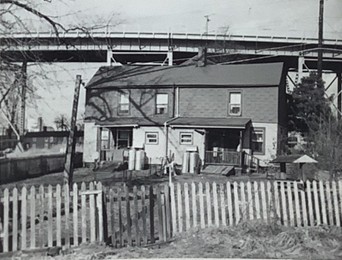
Photo of 47 Main Street, Portland, CT – Property of Sebastian and Eleanor Milardo, 1973
Portland Redevelopment Agency, Town of Portland, CT Archives
Federal funding for urban renewal ended in the mid-1970s and the program’s legacy around the country is enduring and complicated. Many in Portland do not know that there used to be dozens of families living, working, and playing in what is now largely an industrial area. The neighborhood under the bridge has been gone for decades, but the oral histories bring back the sounds, smells, emotions, and other memories of a community displaced by urban renewal.