


By Amanda Rivera
Did you know that one of the oldest Puerto Rican university organizations in Connecticut was established at Yale University in 1971? Despierta Boricua was founded in 1971, in the basement offices of Durfee Hall on Yale University’s “Old Campus.”
Formation of Despierta Boricua
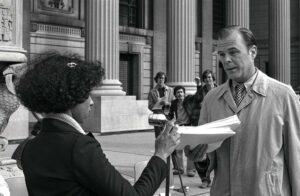
Yvette Martas, YC 81, presents University Secretary Henry Chauncey with a list of student demands that Yale divest from South Africa, Spring 1979. Members of Despierta Boricua collaborated with other groups in a movement that spread to other universities in the Northeast. Photo by David Gonzalez
Inspired by multiple activist movements of the time, five students came together to create the organization: freshmen Eduardo Padró and Cruz Ramos (Class of 1975); sophomore Gilberto “Gilbert” Casellas (Class of 1974); junior Hector Medina (Class of 1973); and law school student Manuel Del Valle (Yale Law, Class of 1974). Despierta Boricua’s numbers were initially small and predominantly male—a consequence of Yale becoming co-ed just a few years prior in 1969. They named the organization “Despierta Boricua,” short for “Despierta Boricua, y defiende lo que tuyo!” (“Wake up Puerto Ricoan, and defend what’s yours!”) The name is from a political slogan of the Young Lords, a group of Puerto Rican activists similar to the Black Panthers, who had chapters in Chicago, New York, and nearby Bridgeport, Connecticut.
The Yale students were also inspired by ASPIRA, a Puerto Rican educational advocacy organization based in New York created to address the significant dropout rate of Puerto Rican high schoolers. Around the same time, Puerto Rican student groups were also forming on other college campuses; the Puerto Rican Institute for Student Action (PRISA) started at the City College of New York in 1969 and the Puerto Rican Student Movement started at the University of Connecticut in 1970.
Despierta Boricua organized itself around four core political goals:
- To bolster Puerto Rican presence on campus and support “our own academic, emotional, intellectual, and social development”
- To establish educational programming which adequately addressed Puerto Rican “needs and struggles,” both on the island and in the mainland United States
- To challenge social pressure to culturally assimilate and elevate “the positive aspects of our Puerto Rican cultural heritage and identity”
- To build connections with Puerto Ricans across the diaspora, including within New Haven, and strengthen solidarities with “other Third World Groups”
Building on Other Movements
Crucially, the activism of Black students on campus laid the groundwork to make Despierta Boricua’s early successes possible. The Black Student Alliance at Yale (BSAY), which formed in 1967, actively combatted institutional racism at the university and in New Haven. Fueled by the growing Black Power movement of the late 1960s, Black students at Yale initiated their own admissions recruiting process and established both the African American Cultural Center and the first African American Studies program amongst the Ivy League institutions. They were also key mobilizers in the May Day Protests of 1970, which saw the confrontation of the anti-war movement and the trials of Black Panthers Bobby Seale and Ericka Huggins on the New Haven Green.
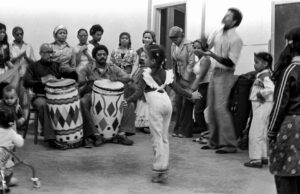
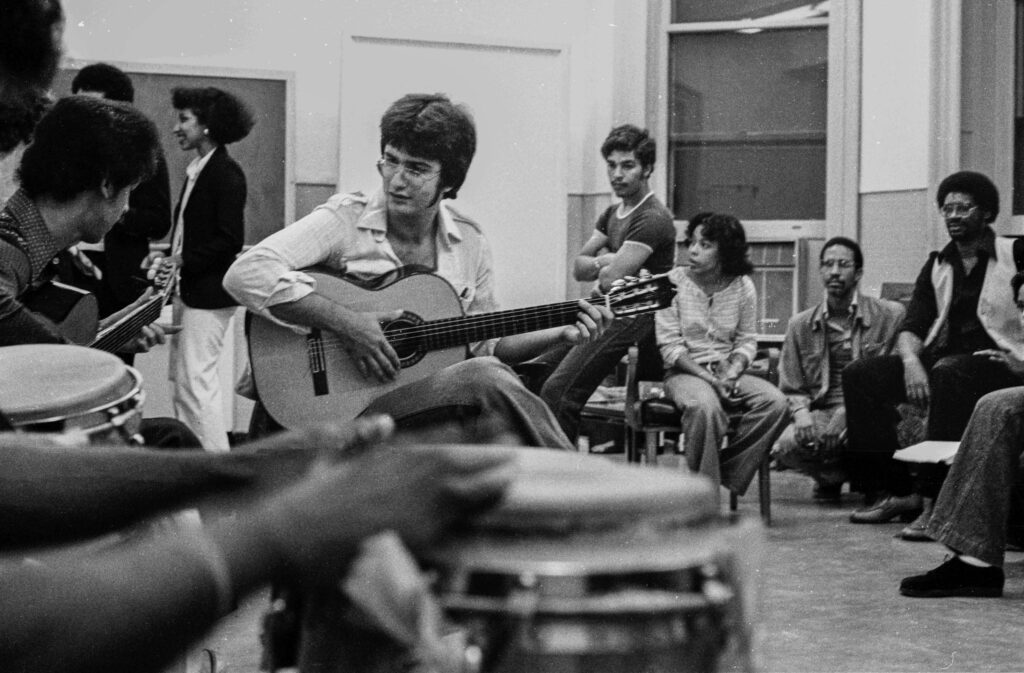
301 Crown was used as a practice space for the Loizenos Ausentes, a local Bomba and Plena group led by Grammy-winning Salsa vocalist Henry Alvarez, left, on drum. Tomas Filomeno, YC 79, a DB member who also performed with the group. Photo by David Gonzalez
In turn, Puerto Rican students at Yale made similar political demands, including increased Puerto Rican admissions, the establishment of a Puerto Rican Studies program at the university, and the establishment of the first Puerto Rican cultural center on an Ivy League campus. In the 1970s, Yale established La Casa Cultural Julia de Burgos—named after Afro-Puerto Rican poet and pro-independence activist Julia de Burgos—to provide programming to Puerto Ricans at Yale and in New Haven.
50 Years of Activism
Despierta Boricua’s activism shifted throughout its history. In the 1980s, student members channeled their energy around recruiting more Puerto Rican students. They also organized guest lecturers to teach seminars on Puerto Rican history and culture.
In the 1990s, student members wanted to bridge divides between Puerto Ricans born on the island of Puerto Rico and those born in the mainland United States. Despierta Boricua hosted a conference in 1991 debating the island’s political status as a colony of the United States. In 2021, Despierta Boricua celebrated their 50 year anniversary, and continues to provide a space for Yale students to organize around Puerto Rican heritage and culture today.
Amanda Rivera is a 6th-year PhD candidate in the Department of American Studies at Yale University, studying Puerto Rican educational activism in and around New Haven, Connecticut.”