


by Robert J. Weiner Jr.
With a life span of nearly 102 years that began before the American Revolution and ended during the Civil War, Daniel Waldo was a celebrated clergyman noted for his patriotism and longevity. As a teenager, he served as a colonial soldier before embarking on a long career as a Congregationalist minister in Connecticut and New York. “Father Waldo,” as he became known, rose to prominence as a chaplain for the U.S. Congress during the crisis-ridden Antebellum years. His healing presence helped bring peace and unity to Washington following a horrendous act of violence carried out inside the Capital.
Early Life
Born on September 10, 1762, Waldo was one of 13 children of Zacheus and Tabitha (Kingsbury) Waldo of Windham, Connecticut. In April 1779, the 16-year-old Waldo joined the Connecticut militia where he served for one month building a fort on the shores of New London. Lacking an official name, the soldiers dubbed it “Fort Nonesuch” due to its small size and few cannon mounts.
A year later, Waldo re-enlisted as part of a new regiment stationed in the town of Horse Neck (near Greenwich). The regiment safeguarded a critical supply base in that area from British and Loyalist forces stationed along the Connecticut-New York border. In December 1780, the forces launched a surprise raid and captured all the soldiers, including Waldo. Transported to Manhattan’s overcrowded, disease-ridden “Sugar House” prison and held there for two months, a prisoner exchange finally ended his ordeal, and, with his enlistment completed, he returned home to Connecticut.
Of his military experience, Waldo wrote, “I exposed my life and endured much suffering for our country’s independence and formation of our glorious union.”
“Father Waldo”
Returning to civilian life, Waldo began his religious studies and subsequently graduated from Yale’s Divinity School in 1788. He also married Nancy Hanchett of Suffield in 1795 and fathered five sons. Devoting his life to the ministry, Waldo served many parishes over the years, including almost 20 years in West Suffolk.
In 1835, by then in his early 70’s, Waldo, along with his wife and other family members, left Connecticut, eventually settling in Syracuse, New York. Active as a guest minister and chaplain in his new community, Waldo became well-known for his wisdom and benevolence, which earned him the nickname “Father Waldo.”
Striving for National Unity
New York Congressman Amos P. Granger saw the minister as an ideal candidate for a congressional chaplain. Waldo’s Revolutionary War service made him a figure who could appeal to both slaveholding and free states, helping to unite otherwise contentious statesmen; the House of Representatives rallied around the old soldier, voting him chaplain in 1856. Of his first session, newspapers complimented the 94-year-old Waldo on his agelessness, gentlemanly manner, and agreeable voice.
In early 1857, Waldo faced the daunting task of preparing a eulogy for the deceased Preston Brooks, the North Carolina Representative, who several months earlier had savagely beat Massachusetts Senator Charles Sumner with a cane on the Senate floor. The attack was in retaliation for a speech Sumner gave where he harshly denounced slavery and slaveholders. Waldo focused his funeral message on the theme of penitence, which succeeded in easing the day’s tension-filled atmosphere.
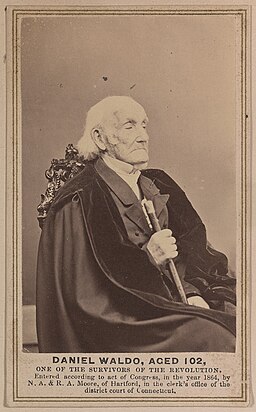
After a second term as chaplain, Waldo retired from Congress, but the soon-to-be centenarian remained a fixture in national newspapers. In 1861, he was among the dignitaries who welcomed President-elect Lincoln when his inaugural train made a brief stop in Syracuse enroute to Washington. In another news story, Yale touted Waldo as its oldest living graduate. Like other notables of the time, he posed for a carte de visite, the then-popular photo card, which he would autograph upon request like celebrities of today.
Honoring the Men of the Revolution
As the Civil War dragged on, the country needed a morale booster, and attention turned to the patriotic Revolutionary War period when all states stood united. In 1864, Congress passed a resolution giving thanks “to the gallant surviving soldiers of the Revolution, twelve in number now,” which included Waldo.
Afterward, two pioneering photographers from Hartford, brothers Nelson and Roswell Moore, decided to locate the survivors and capture their images as portraits. After sending inquiries, they discovered that 6 of the 12 veterans were still alive and living in northern states. Time was critical as the photographers set out to complete their task. A trip to Syracuse succeeded in capturing several poses of Waldo, who was now facing vision and mobility challenges. “My health is good, but my sight is nearly gone,” Waldo wrote to a friend. “However, I spend my time very pleasantly, and I trust, profitably, in meditation and prayer. I enjoy the society of my friends as well, … and am always most happy to welcome them at my home. I can hear them, if I cannot, see them [.]”
The Rev. Elias Hillard of the First Congregational Church of Berlin joined the project to interview each survivor about their military service and live, writing individual profiles on each man. Hillard, the Moore brothers, and printer H. S. Griffiths of Hartford later combined the profiles and portraits into a book entitled The Last Men of the Revolution.
A Fond Farewell
After traveling from Connecticut to Syracuse in the summer of 1864, Hillard learned that Waldo was in a coma following a recent fall. Upon seeing the ailing man, Hillard wrote: “The sight of him … was beautiful and touching. …His look was as peaceful and pleasant as when in health[.]” To craft a narrative for Waldo’s chapter, Hillard spoke to friends and relatives about their beloved “Father Waldo.” Soon after, on July 30, 1864, Waldo died just a few months shy of his 102nd birthday.
Hundreds filled Plymouth Congregational Church in Syracuse for Waldo’s funeral; he was buried in Rose Hill Cemetery. Afterward, officials printed the eulogy as a booklet for those unable to attend the service and as a final keepsake for an adoring public. Months later, with the publication of The Last Men of the Revolution, Americans near and far had a further opportunity to contemplate the long life and final days of Rev. Daniel Waldo.
About Robert J. Weiner Jr.- With a keen interest in history and genealogy, Robert J. Weiner Jr. is a librarian emeritus at Syracuse University.